
Failure analysis: Wrong choice of lubricants
Detection and precise identification of lubricants and their coatings using TOF-SIMS
Detection and precise identification of lubricants and their coatings using TOF-SIMSLubricants are used in almost all technical products today. They are used as contact, corrosion and wear protection and have a cooling, damping or friction-reducing effect. They are used a lot, especially in moving parts where flawless use must be guaranteed, as forces and friction act there.
Depending on the machines, they have to meet different requirements, which is why there are a large number of customized lubricants. The right choice can reduce costs and make better use of resources, for example by extending service life. Lubricants tailored to the application can thus shorten maintenance intervals, reduce downtimes or lower energy consumption.
In material and damage analysis, the wrong lubricants are often identified as the cause of damage to machines or technical components. The wrong choice becomes apparent through increased wear or collateral damage. In addition, the creeping properties or outgassing of a lubricant can lead to indirect foreign contamination in the vicinity of the component, such as deposits on electrical contacts of neighboring components.
(see applicationsnote: Identification of emission products)
The reason for selecting the wrong lubricant is often a lack of knowledge about the detailed chemical composition of the lubricant. Also, supposedly equivalent lubricants are used for cost reasons. However, these cannot provide the same performance due to their different chemical composition. In addition, supposedly equivalent lubricants are purchased for reasons of cost efficiency, but these cannot provide the same performance due to their different chemical composition.
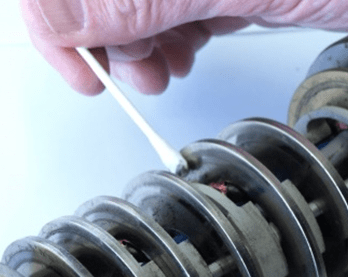

TOF-SIMS: Failure analysis of lubricants
Example of sample
Droplets
Aerosol
Schlämme
Typical occurrence
- Residues from lubricants on metal and contact surfaces
- Deposits on electrical contacts
- Lubricant leakage from bearing
- Leakage from seals
- Wear particles of moving components
- Foreign particles / impurities
- Decomposition/outgassing of lubricants during operation
- Ambient air from production facilities
- Drying after a long service life
- Residues of lubricants
- Mixture of particles and lubricants in gearboxes
- Deposition of impurities and lubricants
The combination of a large number of excipients, fillers and active ingredients, as well as the use of different dosage forms, can lead to various problems in quality assurance. Specific application examples are, for example, the contamination of citalopram tablets by zinc bromide or the precise characterization of the layer structure of an omeprazole preparation.
Results and imaging of TOF-SIMS analysis of pharmaceutical products
Compared to many other methods of instrumental analysis, TOF-SIMS is not limited to the chemical analysis of individual special substances and substance groups. The high sensitivity of TOF-SIMS analysis enables the identification of all chemical species present, and a spatially resolved representation of the detected chemical substances is also possible. Depending on the analysis objective, the data can be visualized as mass spectra or as spatially resolved images.
Identification of the combination of active ingredients in a veterinary medicine
One advantage of the TOF-SIMS method for material analysis of pharmaceutical products is the identification of active ingredients, excipients and fillers in one analysis. In this example, both active ingredients (paracetamol and meloxicam) are detected in a veterinary medicine.

The results of the material analysis show that different base oils are used:
• Long-chain hydrocarbons (A)
• Trimellitic acid esters (B)
• Fatty acid esters (C)
The choice of base oil has a significant impact on the functionality and viscosity of the lubricant.
Case Study 2: Identification of Additives in Lubricants

Analysis of polymer-based lubricants
Summary of results: TOF-SIMS for precise damage analysis and quality control
Precise chemical analyses using TOFSIMS down to the µm range enable the reliable identification of chemical substances. In this way, the cause of quality deviations such as impurities, discoloration, residues, foreign particles and other material defects can be found.
Contact us if you have any questions about the chemical composition and layer structure of your pharmaceutical products. We support you in troubleshooting and damage analysis as well as in monitoring the long-term stability (degradation) of your products. Our team will be happy to help you with any questions or problems you may have – also in other sectors.
Veröffentlichungen
¹Kollateralschäden durch falsche Schmierstoffe.
H.Feld N. Oberender J. Hellwig: mo Magazin für Oberflächentechnik, 76 (2022) (9) 52 – 56.
²Nachweis und Identifizierung von Schmierstoffbelägen in der Fehler- und Schadensanalytik (1/2).
H.Feld N. Oberender J. Hellwig: Oberflächen Polysurfaces, 3 (2022) 13 – 17.
