Quaternary ammonium compounds (QACs) in disinfectants as an unknown cause of damage
The Uncontrolled Spread of Cleaning Agents and Its Consequences for People and Materials: A Surface Analytical Perspective
In everyday life, using cleaning agents to keep surfaces clean and hygienic is second nature. Due to their germicidal properties and surfactant effects, quaternary ammonium compounds (QACs) are the active ingredient in most cleaning agents and disinfectants, used in industrial, medical and household settings. QACs are cationic biocides with surfactant properties. Examples of common QACs include benzalkonium salts (such as benzalkonium chloride, or BAC) and dialkyldimethylammonium salts (such as DDAC, DSDMA and DTDMAC).
Because they are so widely used, they are increasingly finding their way into the environment and our daily lives—often unnoticed. However, this trend has far-reaching consequences for health, the environment, and material quality.
Apart from its direct effects on humans (allergies, poisoning), the germicidal effect is undesirable in nature and, for example, in wastewater treatment plants, since many microorganisms perform important functions and QAV exposure can also be one of the causes of the formation of antibiotic-resistant bacteria (MRSA). Furthermore, exposure to QAVs can cause damage to products and materials, such as flow defects, cracks, blisters, and delamination.
Analysis of QAVs using TOF-SIMS
Quaternary ammonium compounds (QACs) are organic compounds that belong to the group of cationic surfactants. They consist of a hydrophilic (water-soluble) nitrogen-containing head group and a lipophilic (fat-soluble) organic tail. Due to this molecular structure, QACs exhibit excellent surface-active properties. In surface analysis, the TOF-SIMS method (time-of-flight secondary ion mass spectrometry) is used for the chemical characterization of surface substances. Due to its high detection sensitivity, it enables the detection and identification of QACs in trace concentrations. Various sample types can be analyzed—ranging from direct surface analysis and wipe samples to the characterization of aerosol samples (in-house method, see OFG application example F-VII).
Case Study 1: QAVs in Medicine
In the medical field, quaternary ammonium compounds (QACs) are used in large quantities on a daily basis. In addition to their use as preservatives or antiseptics, QACs are employed in hospitals and medical facilities as disinfectants for instruments, rooms, surfaces, and floors. In the process, QAC residues often remain invisible, for example on medical devices such as arterial clamps or implant screws. In addition, QACs can also enter the air as aerosols, where they can either be inhaled directly or settle on surrounding surfaces.
During the manufacture of pharmaceutical products, QACs can also end up on packaging or even on the medications themselves. Consequently, unintended contamination occurs.
Case Study 2: Food
Quaternary ammonium compounds (QACs) are also widely used in food production. For example, QACs can come into contact with plant-based foods as early as the cultivation stage through the use of plant protection products (pesticides) or fertilizers. In later stages of production during the processing of plant-based or animal-based products, further contamination can occur through hand or surface disinfection. As the process continues, there is a risk that QACs may end up in finished products such as ice cream, salads, or even beverages. Foods high in fat or protein are particularly problematic in this regard, as QACs can easily bind to them due to their lipophilic properties.
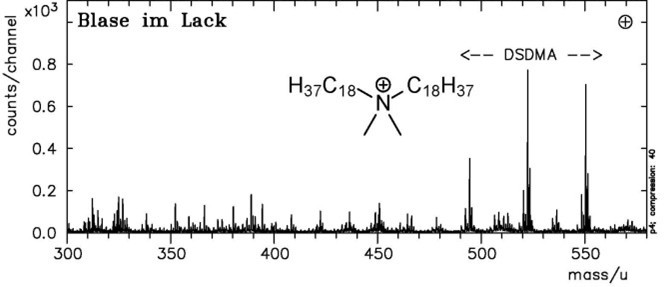
Case Study 3: Property Damage in Industry


Summarized: Damage and Material Analysis Using TOF-SIMS
Quaternary ammonium compounds are far more common in our daily lives than is generally assumed. They are not only used in disinfection but are also unintentionally present in industrial production, food manufacturing, and even in packaging materials.
The consequences are manifold: health risks (e.g., allergies, respiratory diseases), environmental impacts from the destruction of beneficial microorganisms, the potential emergence of antibiotic-resistant pathogens, and material damage to products. The highly sensitive analytical technique TOF-SIMS enables the precise detection and identification of even the lowest concentrations of QACs.
TOF-SIMS is an effective method for surface analysis. This method allows surfaces to be characterized with high precision and QAVs to be clearly identified.
The method is not only used to investigate defects and damage. Through preventive analysis, unwanted contamination can be identified at an early stage, thereby helping to prevent damage.
Please contact us to learn more about our work in surface analysis as well as materials and failure analysis—we would be happy to provide you with practical application examples related to QAV and related topics.
Publications
¹H. Feld, N. Oberender in Hygiene & Medizin, 43-5 (2018) D37-D45: “Die unkontrollierte Verbreitung von quartären Ammoniumverbindungen (QAV) in Alltagsprodukten sowie in medizinischen und industriellen Bereichen – kritisch für Mensch, Material und Umwelt.
²H. Feld in Oberflächen Polysurfaces, 5/16 (2016) 6-11: Problematische Verbreitung von quartären Ammoniumverbindungen in Alltagsprodukten