
Surface analysis
Surface analysis involves the examination of material surfaces to obtain information about their chemical composition and structure (morphology). It enables the reliable characterization of surfaces, interfaces, layers, and solids. Due to its wide range of applications, it is an excellent tool for failure and damage analysis, materials analysis, and materials testing, as well as being important for quality control and research and development (R&D).
What is analyzed?
Surface analysis focuses on the study of surface chemistry and morphology. To ensure a targeted analysis, understanding the background of the question or problem is a crucial step in efficiently selecting appropriate techniques and methods.
For example, if foreign contamination on the surface is suspected to be the cause of staining or discoloration on a component, Time-of-Flight Secondary Ion Mass Spectrometry (TOF-SIMS) is a suitable method.
If, on the other hand, the surface structure needs to be examined—for example, to determine pore sizes after etching—scanning electron microscopy (SEM) is used.
For applications that require a depth profile from the surface into the bulk (such as in semiconductor research), techniques such as X-ray photoelectron spectroscopy (XPS), glow discharge optical emission spectroscopy (GDOES), and time-of-flight secondary ion mass spectrometry (TOF-SIMS) are used.
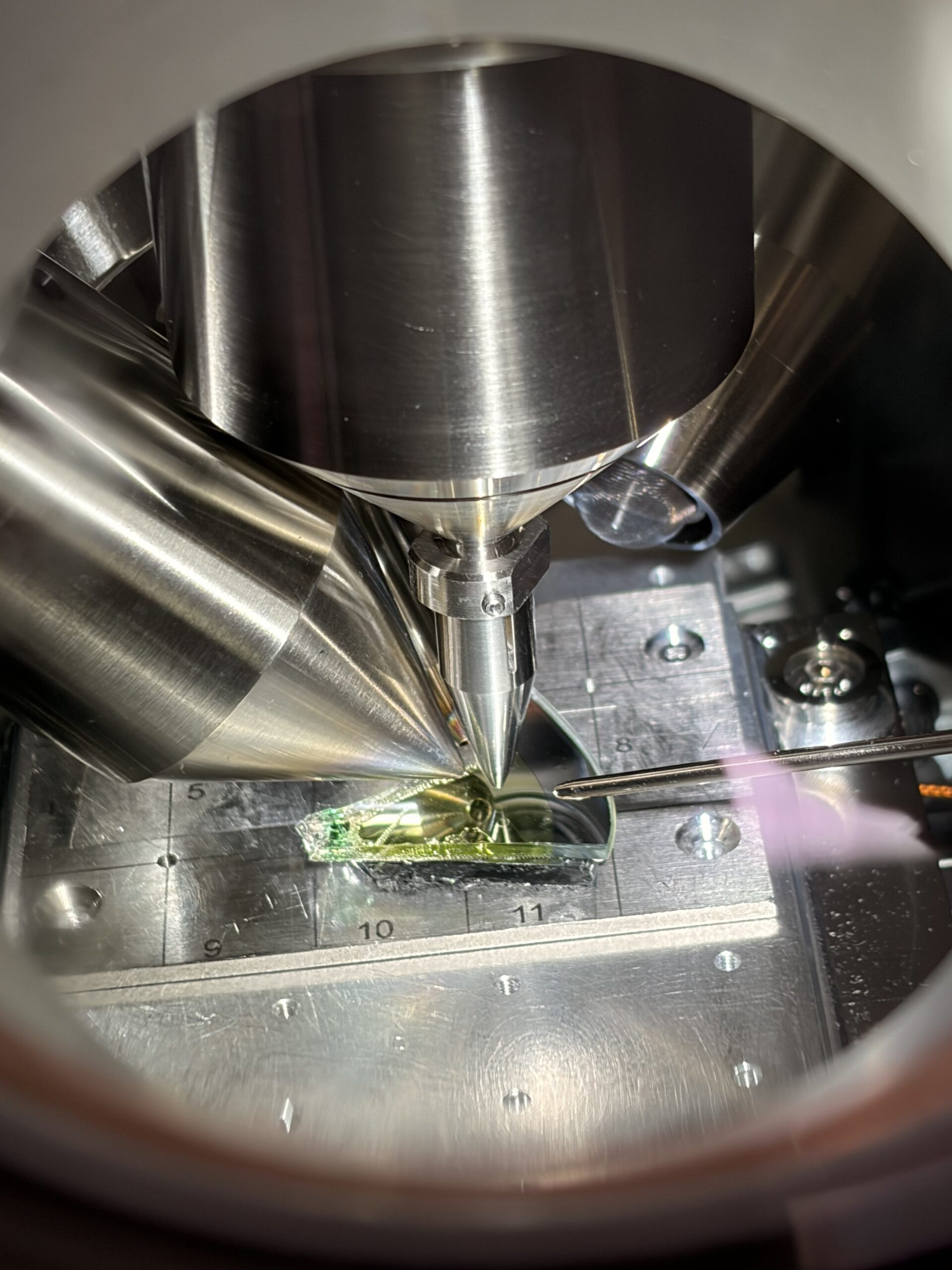
- Chemical Surface Analysis
- Contamination and Residue Analyses
- Damage analyses
- Coating thickness and depth profile analyses
- Topographic surveys
- Microscopic analyses
How does it work?
- TOF-SIMS – Time-of-Flight mass spectrometry
- IR – Infrared Spectroscopy
- XPS – X-ray photoelectron spectroscopy
- REM – Rasterelektronenmikroskopie
- SEM – Scanning Electron Microscopy
- AFM – Atomic Force Microscopy
- Light microscopy
Are you looking for real-world examples of how our methods are applied? Read our case studies.
